

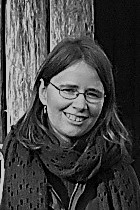
Dr. Anna Varga is a biologist and forest pedagogist who works in ethnobiology, ecology, and environmental humanities. Her research explores questions of silvopastoral systems and non-forest products, environmental education, and (re)connection with nature. She obtained a PhD from the University of Pécs in 2018. Currently, she holds a postdoctoral fellowship (Horizon – MSCA WIDERA) at the Department of Vegetation Ecology at the Institute of Botany, Czech Academy of Sciences, where she works on the project “Hidden in the Forest: Environmental History and Environmental Knowledge of Charcoal Burning in Central and Eastern Europe Since the Nineteenth Century.” Anna was a Carson Fellow in 2019–2020 and Landhaus Fellow in 2023 at the RCC. Her monograph, titled Shepherding the Wild: Wood Pastures, Forest Grazing and Herders in the Region of Bakony and Balaton and Beyond, was published in 2024. She has demonstrated the role of traditional knowledge in wood pasture management and validated their importance and practice of forest grazing in Central and Eastern Europe. Anna has an active role in scientific organizations (Society for Conservation Biology, International Society of Ethnobiology, ICCAs, European Society for Environmental History), communication, and teaching.
RCC Research Project: Hidden in the Forest: Environmental History and Environmental Knowledge of Charcoal Burning in Central and Eastern Europe Since the Nineteenth Century
Selected Publications:
- with Suneetha M. Subramanian, Eszter Kelemen, Alta de Vos, Torsten Krause, Melissa Mayhew, Aroha Mead, Emmanuel O. Nuesiri, et. al. “Inclusion in Body and Mind: Ensuring Full Participation of Indigenous Peoples and Local Communities in Decisions Related to Nature.” Ecology and Society 30, no. 3 (2025). https://doi.org/10.5751/ES-16300-300313.
- A vadon legeltetése. Fás legelők, erdei legeltetés és pásztorvilág a Bakony és Balaton vidékén és azon is túl [Shepherding the Wild: Wood Pastures, Forest Grazing and Herders in Bakony and Balaton Region of Hungary and Beyond]. Veszprém Megyei Honismereti Egyesület, 2024. (Beautiful Hungarian Book Award 2024)
- “Traditional Ecological Knowledge and Land Use Changes of the Puszta Agricultural Estates in the Works of Two Hungarian Writers: Gyula Illyés and Evin Lázár.” In Portraying Countryside in Central European Literature, edited by Jakub Ivánek and Jan Malura. Ústav slovenskej literatúry SAV, 2021.
- with László Demeter, Viktor Ulicsni, Kinga Öllerer, Marianna Biró, Dániel Babai, and Zsolt Molnár. “Prohibited, but still Present: Local and Traditional Knowledge About the Practice and Impact of Forest Grazing by Domestic Livestock in Hungary.” Journal of Ethnobiology and Ethnomedicine 16 (2020). https://doi.org/10.1186/s13002-020-00397-x.
- with Zsolt Molnár, Marianna Biró, László Demeter, Krisztina Gellény, Eszter Miókovics, Ábel Péter Molnár, Krisztina Molnár, Noémi Ujházy, Viktor Ulicsni, and Dániel Babai. “Changing Year-Round Habitat Use of Extensively Grazing Cattle, Sheep and Pigs in East-Central Europe Between 1940 and 2014: Consequences for Conservation and Policy.” Agriculture, Ecosystems & Environment 234 (2016): 142–53. https://doi.org/10.1016/j.agee.2016.05.018.
- with Zsolt Molnár. “The Role of Traditional Ecological Knowledge in Managing Wood-Pastures.” In European Wood-Pastures in Transition: A Social-Ecological Approach, edited by Tibor Hartel and Tobias Plieninger. Routledge, 2014.